WhatsApp has become the unofficial communication system of Pakistani schools. Every class has a parents’ group. Teachers run their own groups. Some schools have dozens, each managed by a different staff member from their personal phone. It works — until it doesn’t.
The problem: informal groups weren’t designed for schools
Noise drowns out important messages
A fee deadline posted at 8 p.m. is buried under 60 “Ok” and thumbs-up replies, forwarded videos, and side conversations by morning. Parents mute the group, then miss the next real announcement.
Privacy concerns
In a group, every parent’s phone number is visible to every other member. Teachers’ personal numbers are exposed to hundreds of families, who then message them at all hours.
Teacher burnout
Teachers become on-call customer service, answering individual questions in a group late at night on their own devices.
No accountability
When a teacher leaves the school, the group — and the communication history — often leaves with their phone. The school has no record of what was said.
Inconsistency
Different groups receive different versions of the same announcement depending on who posted it and how they worded it.
The answer isn’t to abandon WhatsApp
Parents use WhatsApp because it’s convenient and they check it constantly. Fighting that habit is pointless. The goal is to keep WhatsApp as a delivery channel while moving the communication system into the school’s control.
How Aschool does it
Messages sent from the school, not personal phones
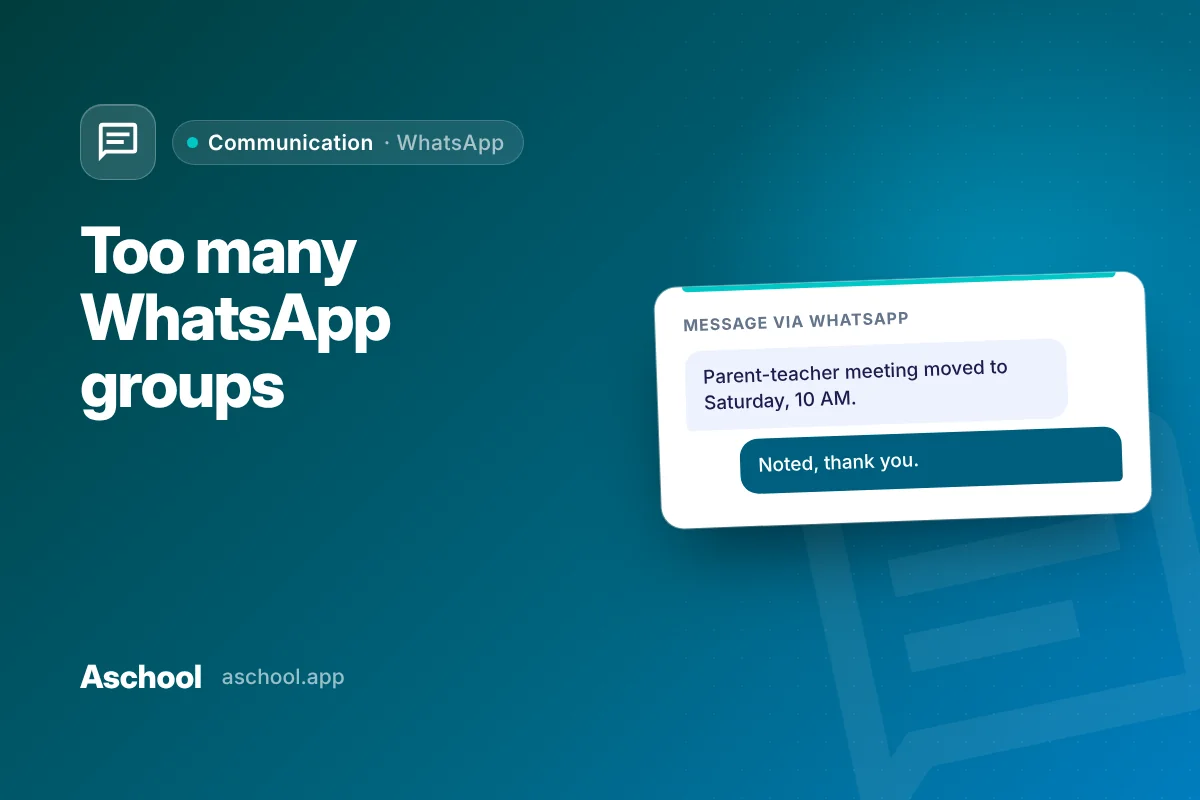
Announcements are created in Aschool’s Communication Center by admins and teachers using their school accounts. Through the WhatsApp bridge, those messages can reach parents’ WhatsApp directly — without a teacher sharing a personal number or managing a group.
Targeted, not broadcast to a crowd
Messages can be sent to the whole school, a class, a section, or a single parent. Parents receive the messages relevant to them, without a group thread of replies around them.
Automatic notifications
Routine updates — attendance marked, results published, a new fee voucher generated — are sent automatically. Teachers don’t need to post them manually.
The school keeps the history
The Communication Center records what was sent to whom. When staff change, the communication record stays with the school.
Questions go through a tracked channel
Parents can raise complaints and queries through the Aschool mobile app and follow them to resolution, instead of messaging a teacher’s personal number at midnight.
Making the transition
- Announce a date after which official notices come only through Aschool.
- Explain to parents that it means fewer messages, not less information.
- Keep class groups, if parents want them, as parent-run social spaces — not the school’s official channel.
Conclusion
WhatsApp is a great delivery channel and a poor school management system. Use it for what it’s good at. Book a demo of the Communication Center.