Let’s start with a defence of the spreadsheet. For many schools, moving from paper registers to Excel or Google Sheets was a real step forward. Sums calculate themselves, lists can be sorted, and files can be emailed. Plenty of well-run schools still depend on spreadsheets today.
But there’s a point at which a spreadsheet stops helping and starts holding a school back. Here’s why.
Problem 1: Spreadsheets depend on one person
Every school spreadsheet has an author — the accountant who built the fee sheet, the coordinator who designed the result template. Over time it fills with formulas, hidden columns, and colour codes only they understand. When that person is on leave or leaves the school, everyone else is afraid to touch the file.
Problem 2: Copies multiply
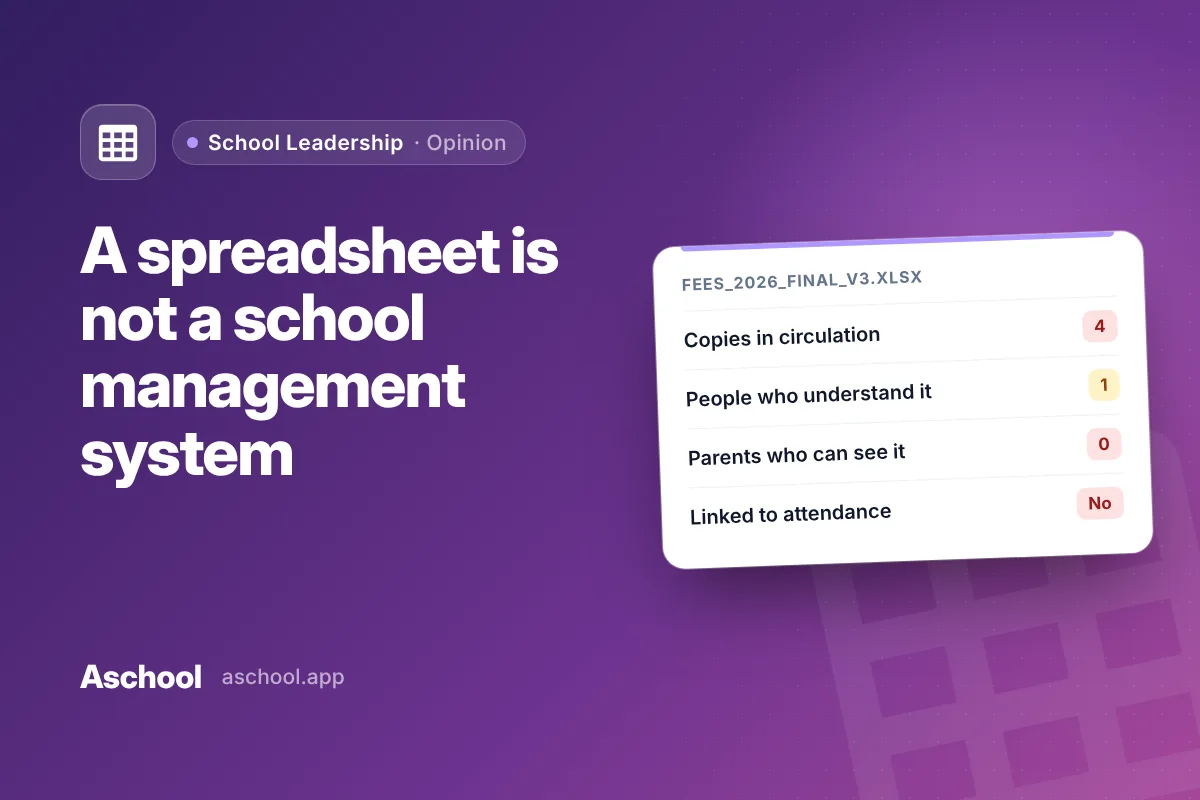
“Fees_2026_final.xlsx”, “Fees_2026_final_v2.xlsx”, “Fees_2026_final_USE THIS ONE.xlsx.” Spreadsheets get emailed, copied to USBs, and edited in parallel. Soon nobody knows which version is the truth.
Problem 3: Nothing is connected
The fee spreadsheet doesn’t know about the attendance spreadsheet. The result sheet doesn’t know that a student changed section. Every connection between them is a person copying data from one file to another.
Problem 4: One wrong formula, silent errors
A formula dragged one row too far, a cell overwritten by accident, a sort applied to one column but not the next — spreadsheet errors are easy to make and hard to spot. They don’t announce themselves; they just quietly produce wrong numbers.
Problem 5: Parents can’t see anything
A spreadsheet lives on an office computer. Parents can’t check their child’s fee status, attendance, or results without calling, because the information isn’t somewhere they can reach.
Problem 6: Access is all or nothing
Share a spreadsheet and the recipient usually sees everything in it — every student’s fees, every staff salary. There’s no simple way to give a teacher access to their class’s marks without exposing the rest.
What a school management system does differently
A purpose-built system like Aschool approaches the same work from a different starting point:
- One shared record for each student and staff member, used by every module.
- Built-in logic for fees, late-fee rules, results, positions, and payroll — not formulas someone has to maintain.
- Roles and permissions, so each person sees what their role requires.
- Parent and teacher portals plus a mobile app, so information reaches the people who need it.
- Reports drawn from live data, not compiled by hand.
When is a spreadsheet still fine?
For one-off analysis, quick calculations, or planning an event, spreadsheets are perfect. The problem is using them as the foundation of daily operations that many people depend on.
Conclusion
Spreadsheets are excellent tools and fragile systems. If your school’s operations rest on files only one person understands, it may be time for a foundation built for the job. Book an Aschool demo.