For students, the new academic year means new books and new classrooms. For the school office, it often means weeks of rebuilding: new registers, new class lists, new fee sheets, new result templates — much of it identical to last year, recreated by hand.
The problem: each session starts on a blank page
In a manual or spreadsheet-based school, the end of one session and the start of the next is a heavy lift:
- Promoted students must be moved to their new classes and sections, one by one.
- New admissions must be added to the right classes.
- Fee structures — often with small increases — must be re-entered for every class.
- Exam formats and grading schemes are rebuilt in new templates.
- Old records have to be archived somewhere they can still be found.
All this happens exactly when teachers and staff are also preparing for the new term. Mistakes made in the rush — a student in the wrong section, a fee not updated — follow the school all year.
How Aschool makes the new session lighter
Academic sessions are part of the structure
In Aschool, academic sessions are configured along with classes, sections, and subjects as part of the school’s basic structure. Attendance, exams, and fees are all scoped to a session, so a new year has a clear starting point while the previous session’s records remain organised.
Exam structures you can reuse
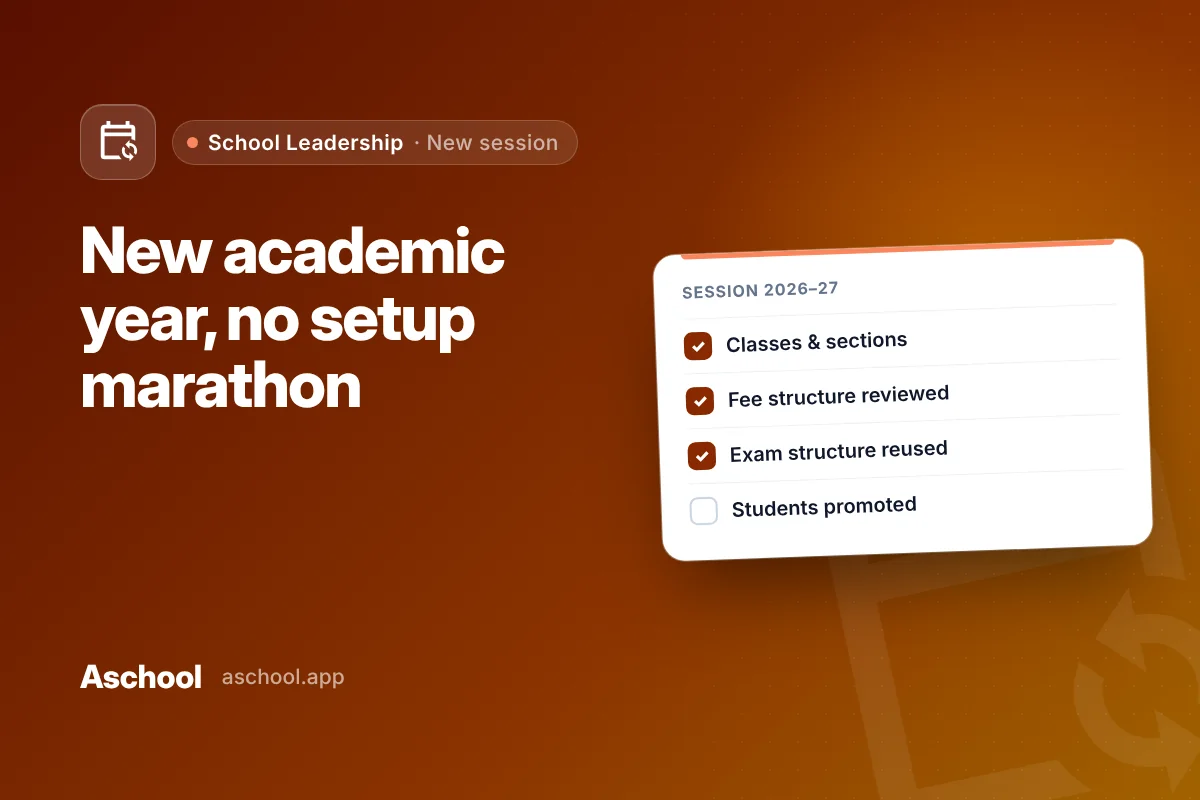
Exam types, subjects, and maximum marks per class are defined once and can be reused for later exams — there’s no rebuilding the grading scheme every year.
Fee structure set per class
Fee heads and amounts are defined per class. When the session begins, vouchers are generated automatically from that structure each billing cycle — no rewriting challans for every student.
New admissions slot straight in
Students confirmed through the admissions process are enrolled directly into their class and section for the active session, with fees ready to generate. They arrive on day one already in the system.
Previous years stay accessible
Because records are tied to sessions, last year’s attendance, results, and fees remain available for reports and reference — no boxes of registers to dig through.
A new-session checklist
- Confirm classes, sections, and subjects for the new session.
- Review and update the fee structure for each class.
- Confirm exam types and grading for the year.
- Place returning and new students in their classes and sections.
- Check parent contact details while families are engaged at the start of the year.
- Review staff roles and permissions.
Conclusion
The start of a new year should feel like a fresh start, not a rebuild. When the structure carries over, staff can focus on welcoming students instead of re-entering data. See Aschool in a demo.