A parent arrives at the front desk holding a crumpled deposit slip. The accounts clerk insists the fee is still pending. The parent insists it was paid before the due date. Both are frustrated, both are partly right, and nobody can prove anything quickly. Twenty minutes later, the clerk is still searching through a box of stamped challans.
Scenes like this happen in schools every month. They’re rarely about dishonesty. They’re about records that don’t line up.
Where fee disputes really come from
1. Multiple copies, multiple versions
A traditional challan has a school copy, a bank copy, and a parent copy. If one is lost, mis-filed, or stamped with the wrong date, the school’s record and the parent’s record no longer match.
2. Late fees applied inconsistently
When late fees are calculated by hand, two parents who paid on the same day can end up with different charges. Once a parent notices that, every future voucher is questioned.
3. No shared view of the truth
The parent sees only their paper copy. The school sees only its register. Neither can see what the other sees, so every disagreement turns into a search for evidence.
The real cost of disputes
Each dispute costs staff time, but the bigger cost is trust. A parent who has had to argue about a payment once becomes suspicious of every voucher afterwards. Some will start paying late on purpose “until the school sorts out its records.” Others mention it to other parents. A small administrative mismatch becomes a reputation problem.
How Aschool removes the source of disputes
One voucher, one record
In Aschool, each voucher is generated once from the class fee structure and exists as a single digital record. The parent’s view in the portal or mobile app and the office’s view in the admin panel are the same record — not two copies that can drift apart.
Due dates and late-fee rules built in
Due dates and late-fee rules are set when the fee cycle is configured, and the system applies them identically to every student. If a parent asks why a late fee was charged, the answer is the same rule that applied to everyone, visible on the voucher itself.
Parents can check before they come in
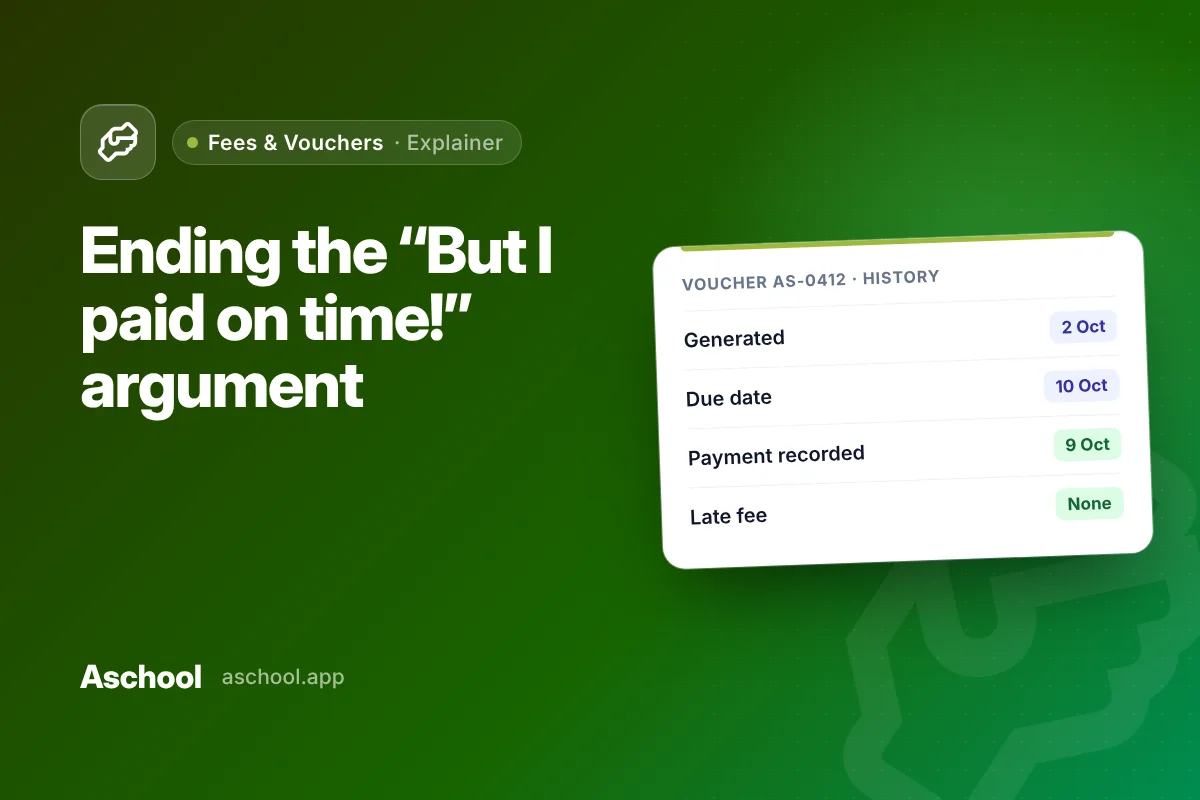
Because current and past vouchers are visible in the parent portal and the Aschool mobile app, many questions are answered before a parent ever reaches the front desk. A parent can see the due date, the amount, and whether the payment has been recorded.
History you can actually look up
When a genuine disagreement does arise, staff aren’t searching boxes. They can open the student’s fee history and see every voucher, its amount, and its status in one place — turning a twenty-minute search into a thirty-second check.
Tips for handling the disputes that remain
- Record payments on the day they’re received, so the system status is always current.
- Encourage parents to check their voucher in the app before paying, so any question is raised early.
- When a mistake is the school’s, correct it quickly and openly — consistent records make that easy to do.
Conclusion
Fee disputes are a symptom of records that live in too many places. Give everyone the same view of the same voucher and most arguments simply never start. Want to see what that looks like in your school? Book a demo of Aschool.