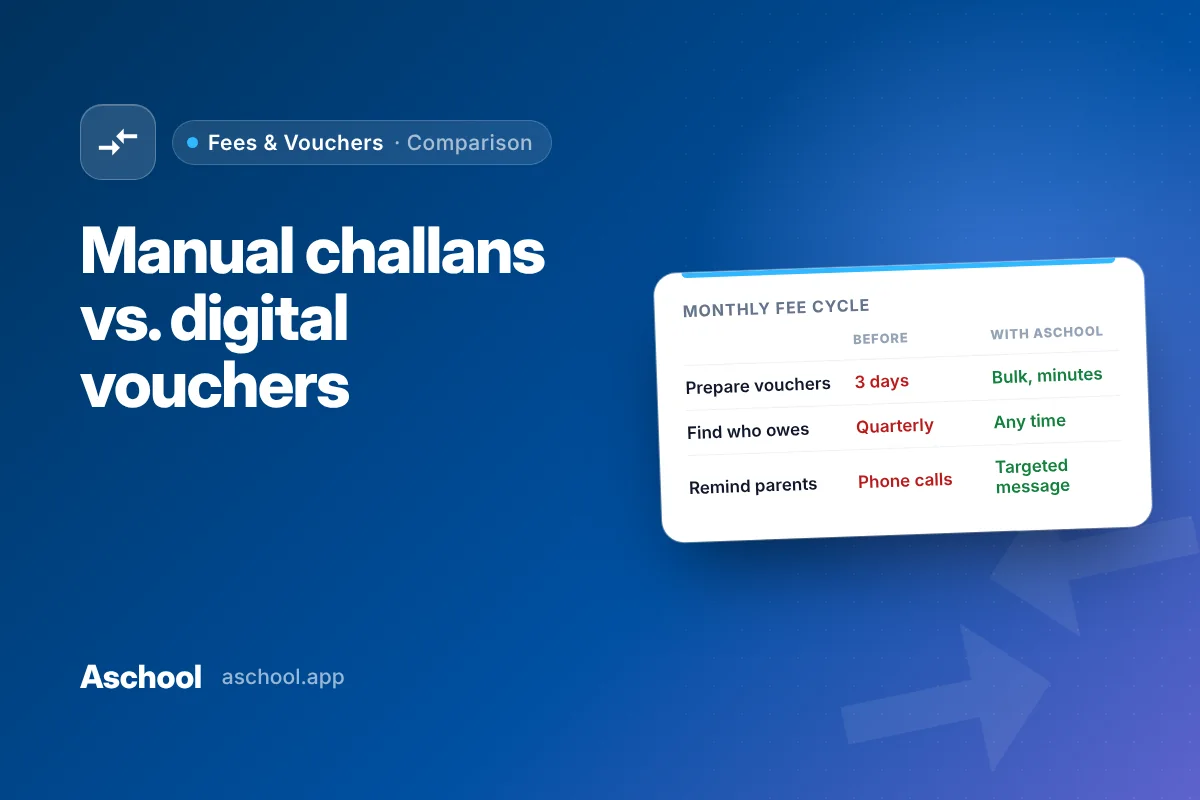
Many schools know their fee process is slow, but it’s hard to say exactly where the time goes. This comparison breaks a typical monthly fee cycle into its individual tasks and looks at how each one works with hand-written challans versus Aschool’s digital voucher system.
The problem with “it’s always been done this way”
Manual fee processes grow over years. A register is added here, a photocopy step there, a separate list for transport fees. Each step made sense when it was introduced, but together they create a cycle that takes days every month and depends on a few experienced staff members who know how it all fits together. When one of them goes on leave, the whole process slows down.
Task-by-task comparison
| Task | Manual challans | Aschool digital vouchers |
|---|---|---|
| Preparing vouchers | Written or printed one by one for every student, every month | Generated in bulk for all enrolled students from the fee structure |
| Adding extra charges (exam, transport) | Added by hand; easy to forget for some students | Configured as fee heads and included automatically |
| Applying late fees | Calculated individually, often inconsistently | Applied by rules set once for the whole cycle |
| Getting vouchers to parents | Sent home in school bags; frequently lost | Available in the parent portal and mobile app |
| Recording payments | Matched against paper copies and bank slips | Status updates on the voucher record itself |
| Finding who hasn’t paid | Full reconciliation of registers, often quarterly | Overdue list available any time, by school or class |
| Reminding parents | Phone calls or notes, one family at a time | Targeted message to only the relevant parents, including WhatsApp |
| Reporting to the owner | Totals prepared by hand from registers | Collection rates and outstanding dues in reports |
What the comparison reveals
Look down the manual column and a pattern appears: almost every task involves re-entering or re-checking information that already exists somewhere else. The student list exists, so why write names on challans? The fee structure exists, so why calculate each voucher by hand? Payments are recorded, so why reconcile separately?
Digital vouchers don’t make the fee process “faster” by rushing staff. They remove the repeated steps altogether.
What doesn’t change
It’s worth being honest: some things stay the same. Someone still needs to decide the fee structure, record payments as they come in, and follow up personally with families in genuine difficulty. Software doesn’t replace that judgment — it gives staff the time and information to exercise it.
Is switching worth it?
If your office spends the first week of every month preparing challans and the last week chasing them, the answer is probably yes. A useful test: count how many hours your staff spent on fees last month, then look at which of those tasks appear in the “manual” column above.
Ready to see the digital column in action? Book an Aschool demo and bring your current fee structure with you.