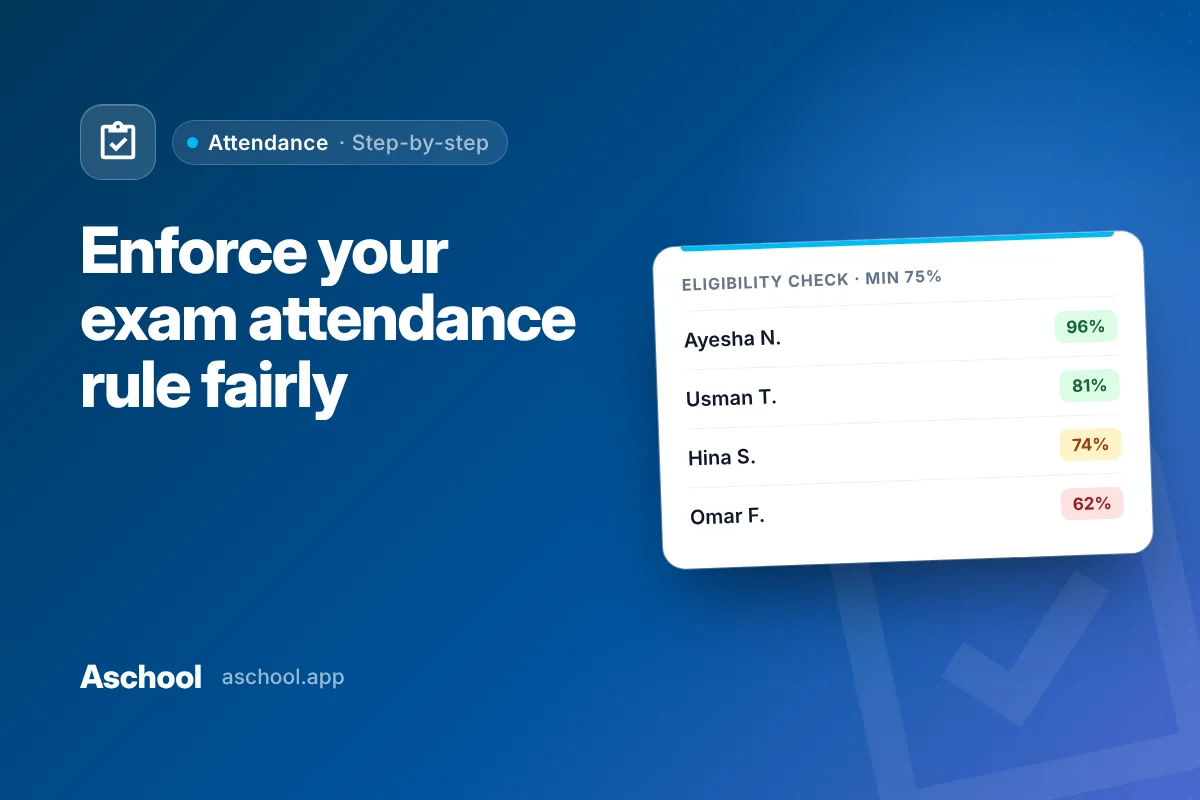
Most schools have a rule along the lines of “students must have at least 75% attendance to appear in the final examination.” It’s a sensible rule. It encourages regular attendance and gives teachers leverage when a student is skipping class. Yet in many schools it’s quietly ignored. Not because anyone disagrees with it — but because checking it is too much work.
The problem: a fair rule that’s hard to apply fairly
To enforce an attendance threshold on paper, someone must:
- collect every register for the term,
- count the working days,
- count each student’s present marks,
- calculate a percentage for every student in every class,
- and double-check the borderline cases, because those are the ones parents will contest.
In a school with twenty sections, that’s days of work at exactly the moment staff are busiest preparing exams. So the rule gets applied selectively — to the students everyone already knows are absent a lot — which is unfair and invites complaints.
Why selective enforcement backfires
When a rule is enforced for some students and not others, parents notice. A family whose child was held back while a classmate with similar attendance wasn’t will feel singled out, and they’ll be right. Inconsistent enforcement erodes the authority of the rule itself.
Step-by-step: enforcing the rule with Aschool
Step 1: Keep attendance in the system all term
The groundwork is simply having teachers mark attendance in Aschool every day. Each mark is recorded against the student and the active academic session, so the term’s data builds up automatically.
Step 2: Check percentages from existing records
When exams approach, attendance percentages can be checked against the records already being kept day to day. There’s no re-counting — the numbers come from the same data teachers entered all term.
Step 3: Review the borderline cases
Rules need human judgment at the edges. A student at 74% with a documented hospital stay is different from one at 74% because of unexplained absences. Use the data to find the borderline students, then let the principal decide each case on its merits.
Step 4: Warn early, not at the deadline
The kindest way to enforce an attendance rule is to warn families well before the exam. Use the Communication Center to message parents of students approaching the threshold mid-term, while there’s still time to improve.
Step 5: Let parents see the same numbers
Because attendance is visible in the parent portal and mobile app, families can track their child’s attendance throughout the term. Nobody is surprised when the rule is applied.
A note on fairness
The real benefit of system-based checking isn’t speed — it’s consistency. Every student is measured against the same data and the same threshold. That makes the decision easier to explain and much harder to dispute.
Conclusion
An attendance rule only works if it’s applied to everyone. With attendance already recorded digitally, applying it fairly becomes a check, not a project. See how it works in Aschool.