Schools take student attendance seriously. Registers are marked, absences are noted, and parents are informed. Staff attendance, by comparison, often lives in a signature book at the reception desk that nobody reviews until there’s a problem.
The problem: staff absence is costly but invisible
When a teacher is absent, the effect ripples outward. A substitute must be found, or a class sits unsupervised. Lessons are delayed, syllabus targets slip, and another teacher loses a free period they needed for marking. Repeated late arrivals mean first periods start late, day after day.
Yet in many schools, nobody can answer simple questions like:
- Which staff members have taken the most leave this term?
- Are late arrivals concentrated among a few people, or widespread?
- Do absences cluster around particular days or months?
The signature book contains the answers, but extracting them by hand is so slow that it rarely happens.
The fairness problem
When staff attendance isn’t tracked clearly, two problems appear. Hard-working staff feel their reliability goes unnoticed, while a few habitual absentees face no consequences. And when management finally does address absence, it can feel arbitrary because there’s no clear record to point to. Clear data protects both the school and its staff.
How Aschool brings staff attendance into view
Staff attendance recorded alongside everything else
In Aschool, staff attendance is part of the same system that holds staff records and payroll. Attendance isn’t trapped in a book — it’s data the school can actually use.
Summaries for leadership
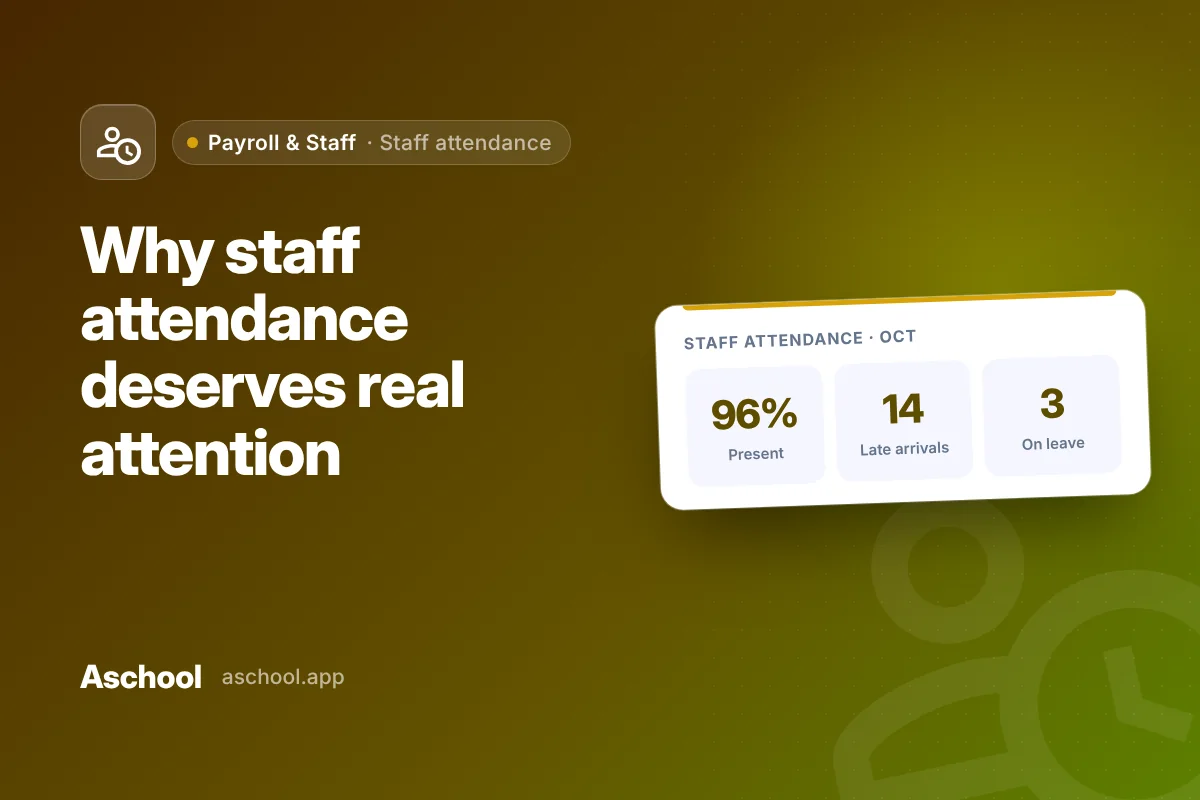
Staff attendance summaries are available as reports. School owners and principals can see attendance patterns without asking the office to count signatures.
Connected to payroll
Because payroll draws on the same staff records, attendance-linked adjustments are based on the recorded data. Staff can see that deductions follow consistent rules, and the accounts office doesn’t have to cross-check a separate register.
Role-based access
With roles and permissions, the right people — principal, HR, accounts — can see what they need, without staff attendance records being open to everyone.
Using the data constructively
- Recognise reliability. Use attendance data to thank staff with excellent records, not only to address problems.
- Look for causes. A cluster of late arrivals might point to a transport issue or an unrealistic start time.
- Talk early. A private conversation after a few weeks of a pattern is kinder and more effective than a formal warning after months.
- Plan cover. Knowing typical absence levels helps you plan substitute arrangements before they’re needed.
Conclusion
Students can only learn when their teachers are in the room. Treating staff attendance as real data — not a signature book — helps schools protect learning time fairly. See Aschool’s staff tools in a demo.