No student becomes a chronic absentee overnight. It usually starts with one Monday missed after a family wedding, then a Friday before a long weekend, then a “slight fever” every few weeks. Individually, none of these absences look alarming. Together, they can add up to weeks of lost learning in a single term.
The problem: paper registers hide patterns
A class register is organised by date. To understand one student’s attendance, a teacher has to scan across dozens of pages and count marks by hand. Nobody has time to do that for every student every week, so patterns stay hidden. Worse, if a student has different teachers for different periods, no single person sees the full picture at all.
By the time absenteeism becomes obvious — usually when exam results drop — the student has already fallen behind and catching up is much harder.
Early warning signs worth watching
- Repeated absences on the same weekday, especially Mondays and Fridays.
- Absences clustered before or after tests, which can signal anxiety or avoidance.
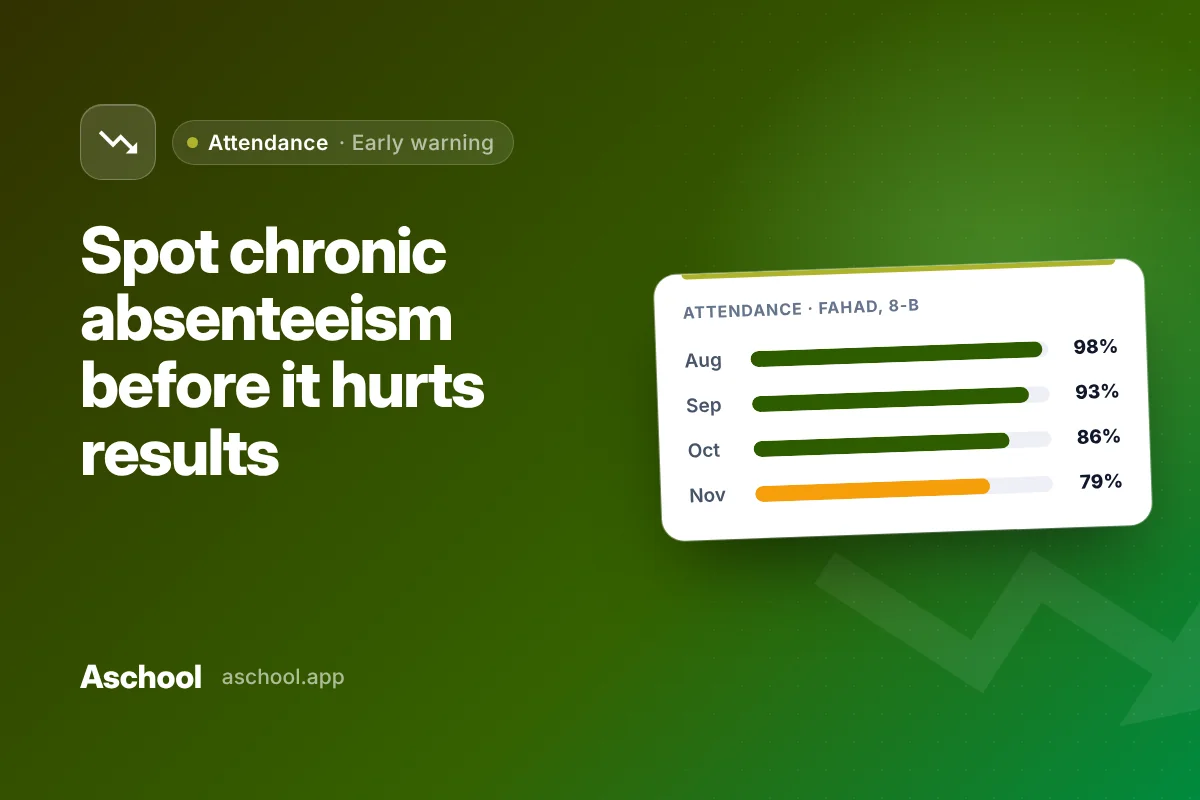
- A gradual decline rather than a sudden drop — for example, 98% attendance in the first month and 85% in the third.
- Absence trends across a whole class, which may point to a timetable, teaching, or transport problem rather than an individual one.
- Attendance and marks falling together, a strong sign that intervention is needed.
How Aschool makes patterns visible
Every mark is stored against the student
When teachers mark daily or per-period attendance in Aschool, each record is saved against the student and the academic session. That means attendance can be viewed by student, not just by date — the view you need to see a pattern.
Trends by class and by student
Admins can pull attendance trends for a whole class or an individual student in seconds. A class whose attendance is slowly slipping stands out, and so does the individual student whose percentage has quietly dropped.
Attendance and results side by side
Aschool’s reporting lets leadership review attendance and exam performance together. When the two decline at the same time, the school has clear evidence to start a conversation with the family — and a specific reason, rather than a vague concern.
Parents see it too
Because parents can check attendance in the portal and mobile app — and receive absence notifications — they’re far less likely to be surprised. Many families correct the habit themselves once they can see it.
A simple intervention ladder
- Notice: review attendance trends at the end of each month.
- Nudge: send a polite message to parents of students below your threshold.
- Talk: if the pattern continues, invite the parents for a short meeting with the data on screen.
- Support: arrange catch-up work so the student isn’t punished twice — once by missing class and again by falling behind.
Conclusion
Absenteeism is one of the most fixable problems in a school — but only if you see it early. When attendance data is organised around students rather than dates, the warning signs become obvious. Book a demo to see Aschool’s attendance trends for yourself.