In many Pakistani schools, the most-read line on a report card isn’t the percentage or the grade. It’s the position: 1st, 2nd, 3rd in class. Parents celebrate it, compare it, and — when it doesn’t match their expectations — question it intensely.
Whatever your school’s view on ranking students, if you publish positions, they need to be beyond doubt.
The problem: positions are the easiest thing to get wrong
Calculating positions by hand means sorting every student in a section by total marks after all totals have been finalized. That sounds simple, but in practice it raises several difficult questions:
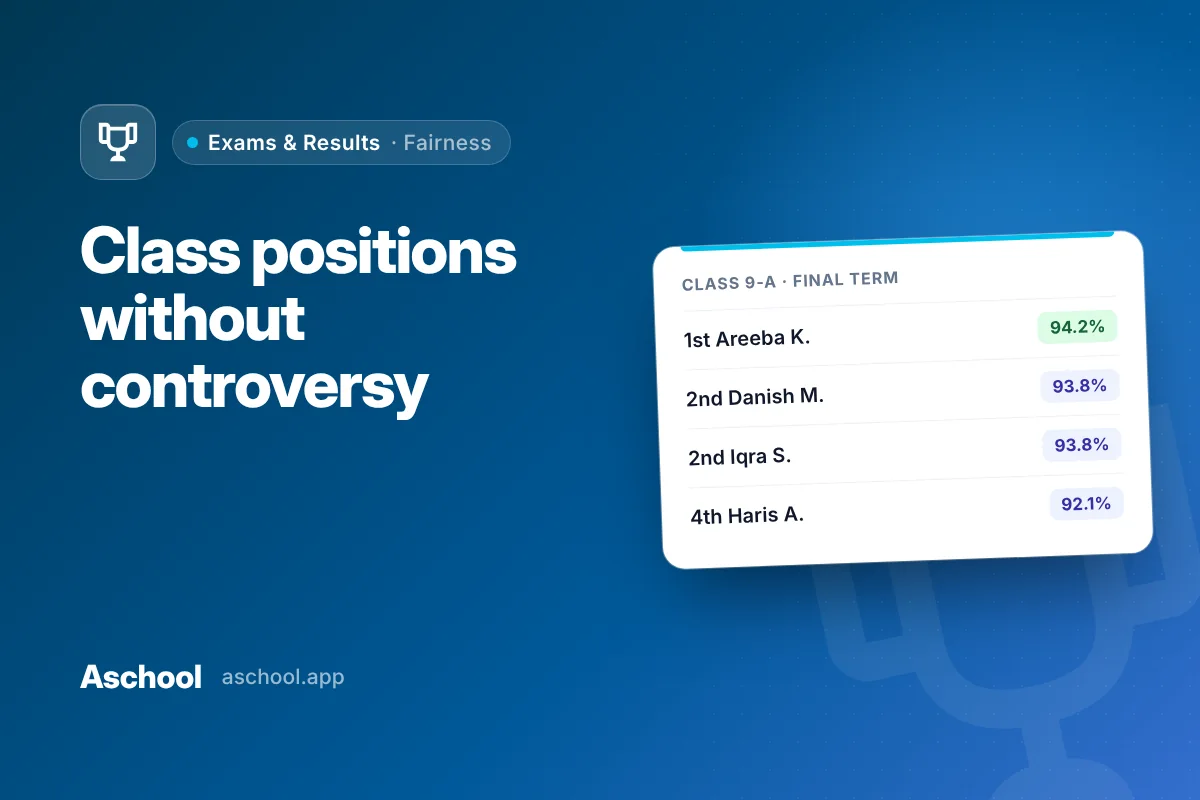
- Ties. Two students with identical totals — do they share a position? Does the next student become 3rd or 4th?
- Late corrections. If one subject mark is corrected after positions are worked out, the ranking for the whole section may change.
- Different teachers, different methods. One section teacher handles ties one way, another section does it differently. Parents with children in both notice.
- Absent subjects. A student who missed one paper may sit oddly in the ranking unless there’s a clear rule.
Each of these is a small judgment call. Made by hand, under time pressure, by different people, they produce rankings that are hard to defend.
Why position disputes are so painful
A dispute over a single mark affects one student. A dispute over a position affects at least two — the one who went down and the one who went up. Correcting it means telling one family their child’s position has dropped after it was announced. Few conversations in school administration are more uncomfortable.
How Aschool keeps positions consistent
Calculated by the system, from final marks
Aschool’s result engine calculates totals, percentages, grades, and class positions from the marks teachers enter. Every section is ranked using the same logic, so there’s no variation between teachers or sections.
Corrections flow through automatically
If a mark is corrected before results are released, totals and positions are recalculated from the updated data. Nobody has to remember to re-sort the class by hand.
Review before parents see anything
Because the school decides when results are published to the parent portal and app, positions can be checked and approved internally first. Most problems are caught before they ever become disputes.
Transparent breakdowns
Parents can see the subject-wise marks behind their child’s total in the app. When a family can see exactly how a total was built, a position becomes much easier to accept.
Good practice for any school that ranks students
- Write down your tie-breaking rule and share it with parents at the start of the year.
- Freeze marks before positions are announced; handle late corrections through a clear process.
- Consider recognising improvement and effort alongside rank, so positions aren’t the only measure of success.
Conclusion
Positions will always matter to families. The school’s job is to make sure they’re calculated the same way for everyone and can be explained in a sentence. Book a demo to see how Aschool handles results from marks entry to ranking.