Every teacher knows the feeling. The exams are over, the papers are marked, and you should be able to breathe. Instead, report card week begins: a stack of mark sheets, a calculator, and a deadline that always seems one day too close.
This guide is for teachers who want to get through results season with their evenings — and their sanity — intact.
Why report card week is so exhausting
The marking itself is real teaching work. The exhaustion comes from everything after it:
- transferring marks from answer sheets to award lists,
- adding totals and calculating percentages for every student,
- converting percentages to grades,
- working out class positions,
- copying everything neatly onto report cards,
- and then checking it all again because one mistake means rewriting a card.
Most of these steps are clerical, not educational. Yet they land on teachers because they’re the ones who have the marks.
Survival tip 1: Enter marks as you finish each subject
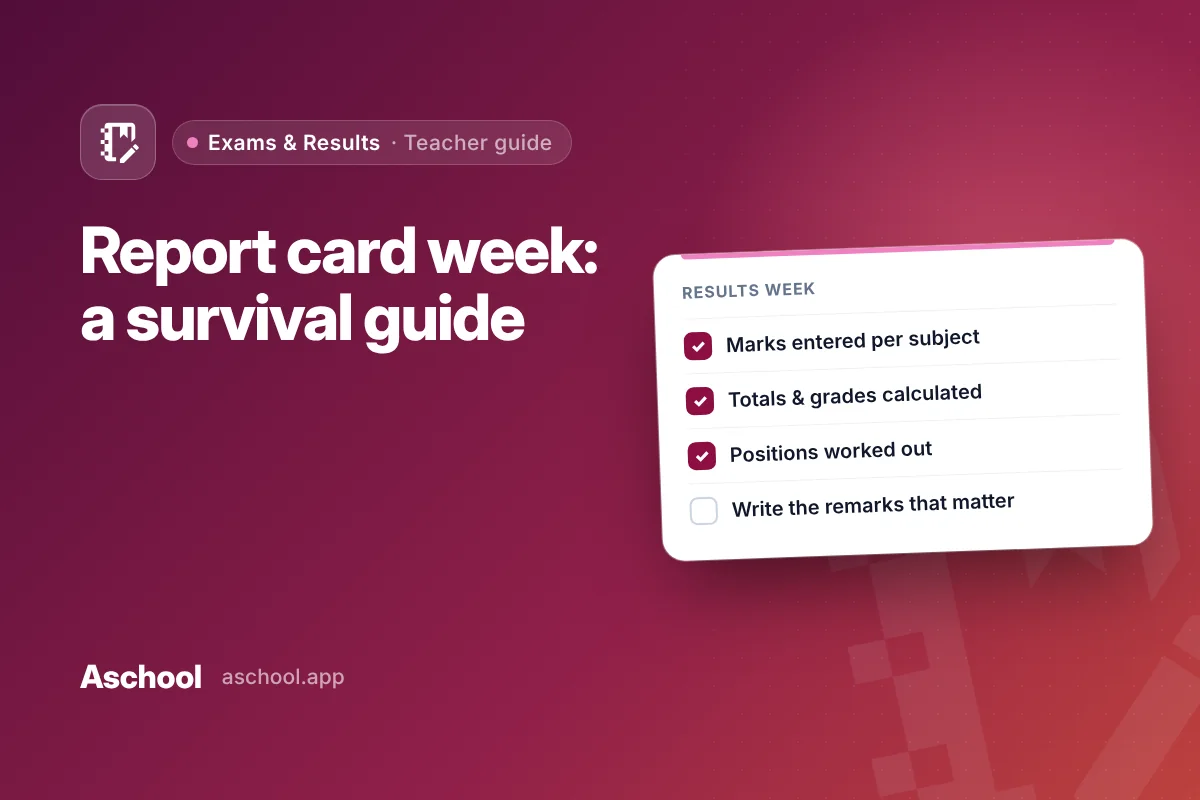
Don’t wait until every paper is marked. Entering marks subject by subject spreads the work across the week and reduces end-of-week panic. In Aschool, teachers enter subject marks per student directly into the system as soon as a set of papers is done.
Survival tip 2: Stop doing arithmetic
Totals, percentages, grades, and positions are calculations, and calculations are what computers are for. In Aschool, once marks are entered, the result engine calculates them consistently for every student. Teachers check the marks; the system does the maths.
Survival tip 3: Use the same structure every term
Re-creating the grading scheme each term wastes time and introduces inconsistencies. Aschool lets the school define exam types, subjects, and maximum marks per class once, and reuse that structure for later exams.
Survival tip 4: Don’t hand-write report cards
Once results are finalized, Aschool generates report cards as PDFs ready for printing, or publishes them directly to the parent portal and mobile app. No more copying numbers onto cards — and no more rewriting a card because of one smudge.
Survival tip 5: Leave time for the comments that matter
The most valuable part of a report card for many parents is the teacher’s remark about how their child is actually doing. When the clerical work disappears, there’s time to write remarks that are specific and helpful instead of a rushed “Good, keep it up.”
Survival tip 6: Agree on a review step
Results should be checked before parents see them. Aschool lets the school control when results become visible, so coordinators and the principal can review everything before it’s released.
Conclusion
Report card week will never be completely relaxing — it’s the end of a term’s work. But it shouldn’t mean late nights with a calculator. Give the arithmetic to the system and keep your time for teaching. Book a demo of Aschool’s exam module.