
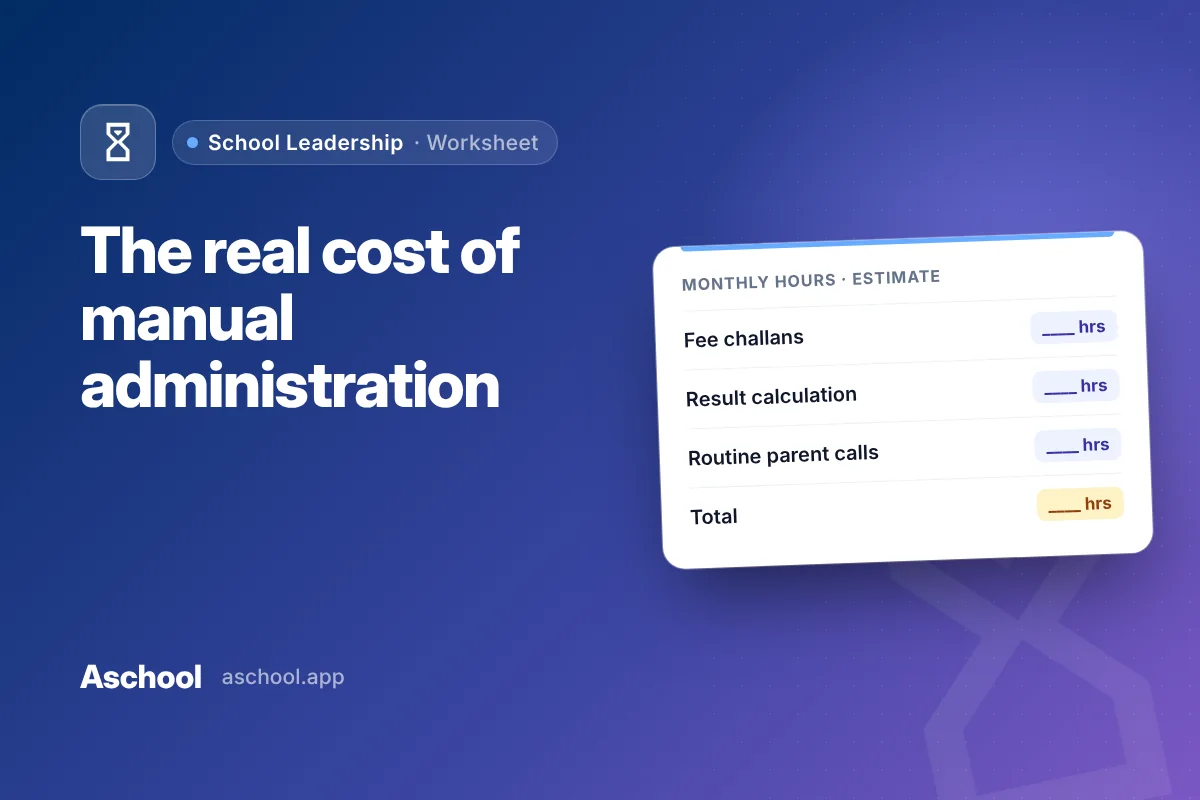
When school owners consider management software, the first question is usually “how much does it cost?” A better first question is “how much is the current way costing us?” Manual administration never arrives as a bill, so its cost stays invisible. This worksheet makes it visible.
The problem: hidden costs feel like zero
Staff salaries are paid whether a clerk spends the day writing challans or following up with families. So manual work feels free. But every hour spent copying names or adding marks is an hour not spent on something more valuable — and some manual processes also cost real money through lost fees and errors.
Part 1: Count the hours
For each task, estimate the hours your staff spend in a typical month. Ask the people who actually do the work.
| Task | Hours per month |
|---|---|
| Preparing and distributing fee challans | ____ |
| Recording payments and reconciling registers | ____ |
| Chasing overdue fees by phone | ____ |
| Compiling attendance figures | ____ |
| Calculating results and writing report cards (average per month) | ____ |
| Calculating payroll | ____ |
| Answering routine parent calls | ____ |
| Sending notices and informing parents | ____ |
| Preparing reports for the owner or board | ____ |
| Updating transport lists | ____ |
| Total | ____ |
Part 2: Put a value on the time
Divide the average monthly salary of the staff involved by their monthly working hours to get an approximate hourly cost. Multiply by your total hours. Don’t forget teachers’ evening hours during result season — that time is real, even if it isn’t paid separately.
Part 3: Count the money that leaks
- Fees never collected because defaults were discovered too late.
- Transport services provided to students who were never billed.
- Late fees not applied consistently.
- Families lost because inquiries weren’t followed up or complaints went unanswered.
Even rough estimates are useful. Most schools find these figures are larger than expected.
Part 4: Consider the risks
Finally, note risks that are hard to price but serious: a report card error that damages your reputation, the office computer that holds every fee record failing, or the one person who understands payroll leaving.
How Aschool changes the numbers
Most tasks in Part 1 map directly to Aschool features: bulk voucher generation and live collection status; attendance marked in the portal with automatic parent notifications; an exam engine that calculates results and produces report cards; payroll runs for all staff at once; a parent app and Communication Center that answer routine questions before they’re asked; and reports built from live data. Part 3’s leaks are addressed by connected records — transport as a fee head, overdue lists, tracked admissions and complaints.
Conclusion
Complete the worksheet, then compare the total with what a system would cost. Bring your numbers to an Aschool demo and we’ll walk through them with you.