
Ask a school owner whether transport makes money and you’ll often get a hesitant answer. Fuel, maintenance, and driver salaries are clear costs. The income side is less clear — and that’s usually because transport fees are leaking.
The problem: two lists that never quite match
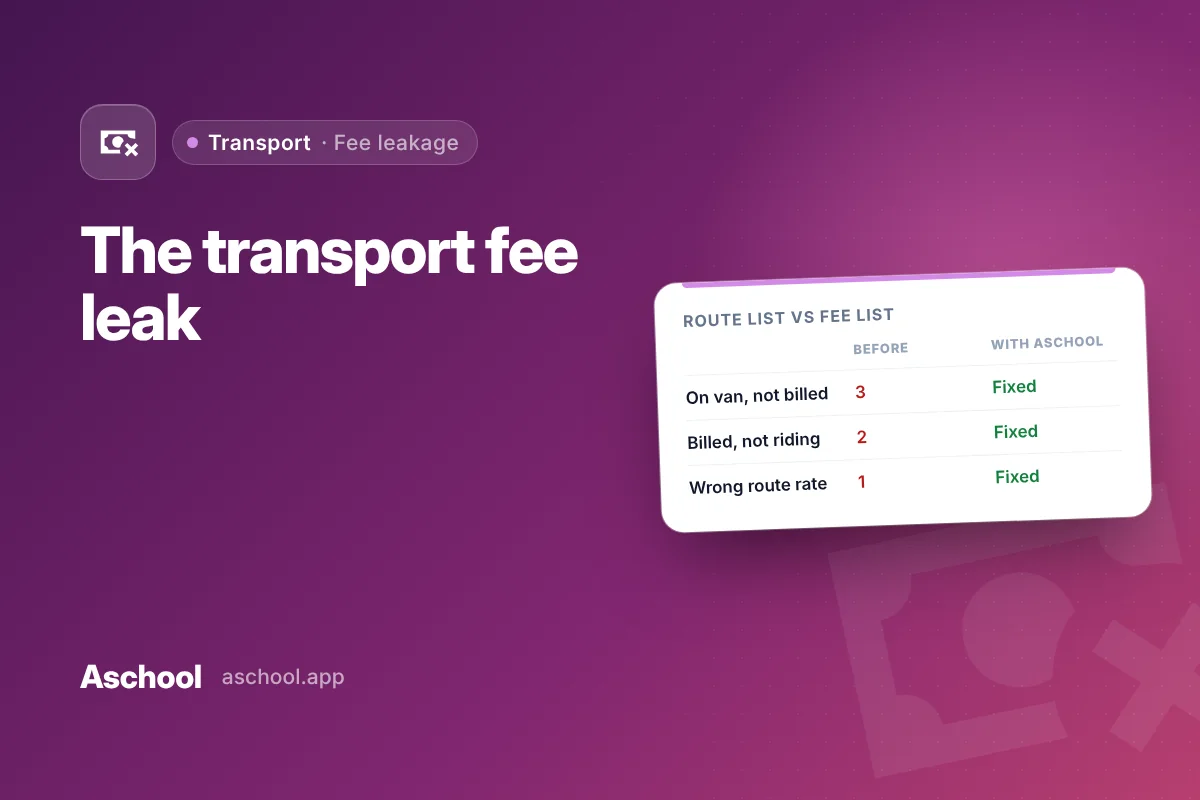
In most manual setups, there are two separate records: the transport in-charge’s list of who rides which van, and the accounts office’s list of who is charged a transport fee. These lists are created at different times by different people and updated independently. Over a year, they drift apart.
The result is leakage in both directions:
- Riding but not billed. A student joins a route mid-term, the driver picks them up, but nobody tells accounts. The school provides the service for free, sometimes for months.
- Billed but not riding. A family stops using the van after moving house, but the fee keeps appearing on vouchers. The parent complains, the fee is reversed, and trust takes a hit.
- Wrong rate. Routes with different distances carry different charges, and a student moved to a longer route stays on the old rate.
Why separate transport invoices make it worse
Some schools issue transport fees on a separate slip from tuition. Parents then have two bills to track, and transport fees — seen as optional — are often the ones paid late or forgotten.
How Aschool keeps transport and fees in sync
One assignment record
In Aschool, each transport student is assigned to a specific vehicle and stop in the transport module. That assignment is the single record of who uses school transport.
Transport as a fee head
Transport charges are configured as their own fee head in the fee structure. They’re billed in the same voucher as tuition, so parents receive one bill and transport fees are collected alongside everything else.
Easy reassignments
When a student changes route or stop, or stops using transport, the change takes a few clicks in the admin portal. Keeping the transport record current is quick, which means it actually happens.
Visible in collection reports
Because transport is a fee head in the same system, its collection can be reviewed alongside other fees, giving owners a clearer picture of whether the service is covering its costs.
A quick transport audit you can do today
- Ask each driver for a list of students they actually pick up.
- Compare it with the list of students charged a transport fee this month.
- Note every mismatch — and estimate what it’s costing in a year.
Most schools that do this exercise find at least a few gaps. The goal is a system where those gaps can’t open in the first place.
Conclusion
Transport doesn’t have to be a money-losing headache. When the route list and the fee list are the same list, leakage stops. See how Aschool connects transport and fees.