At 1:45 p.m., the school phone starts ringing. “My son’s van hasn’t come yet.” “Which van is my daughter on today?” “Is the Gulberg route running late?” The receptionist has a printed route list somewhere, but it’s three months old and has handwritten changes in the margins.
For many schools, the hour after dismissal is the most chaotic of the day — and transport is the reason.
The problem: transport information is scattered
School transport involves a lot of moving parts: vehicles, drivers, routes, stops, and the students assigned to each. In a manual system, this information is typically spread across:
- a printed route list in the office,
- the transport in-charge’s personal notebook or phone,
- each driver’s memory of who they pick up,
- and a separate register of who pays transport fees.
When these sources disagree — and they often do — nobody can answer a parent’s question with confidence. Staff end up calling drivers, who are on the road, to ask who’s on board.
Why it matters
Transport questions are rarely just administrative. A parent asking where the van is often has a quiet worry underneath: is my child safe? A confident, immediate answer reassures them. A hesitant “let me check and call you back” does the opposite, and every unanswered call adds to the next one.
How Aschool organises transport
Vehicles, routes, and stops in one place
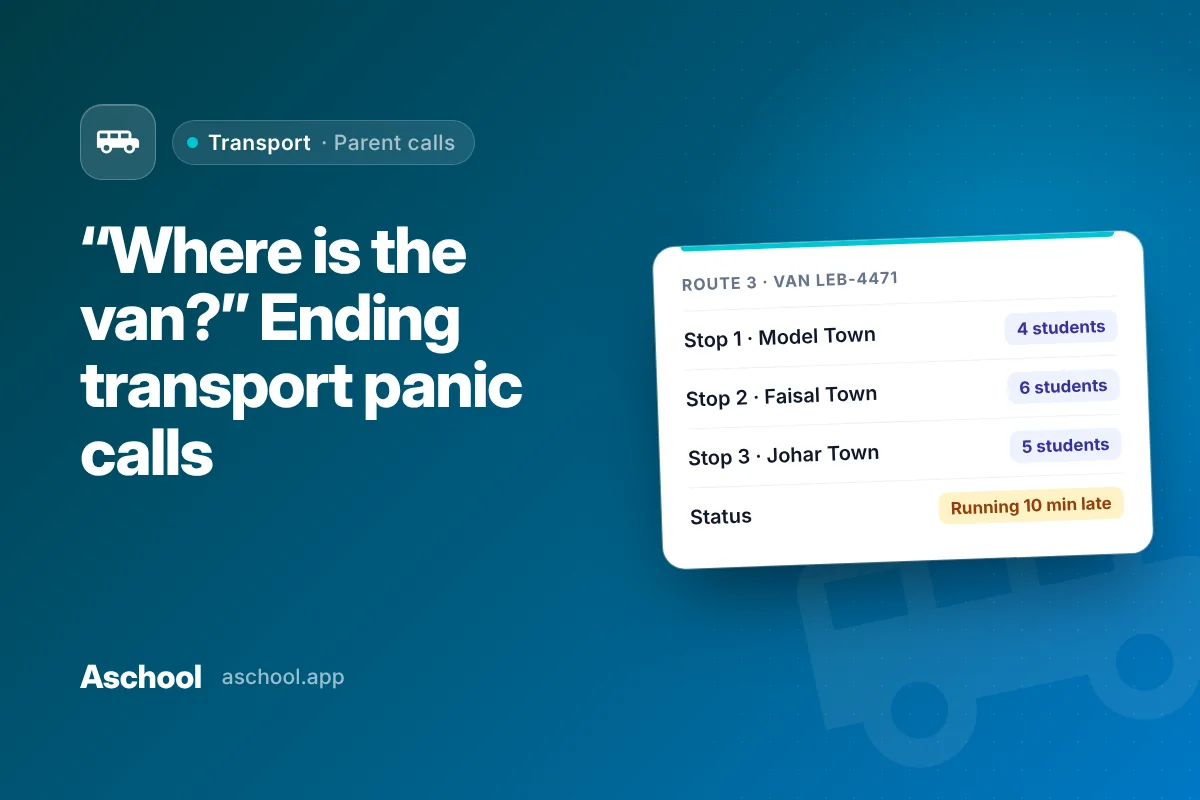
Aschool’s transport module lets the school register each vehicle and define its route and stops. The office always has a current picture of what transport is running and where each vehicle goes.
Every student linked to a vehicle and stop
Each student using school transport is assigned to a specific vehicle and stop. When a parent calls, the receptionist can look up the student and immediately see which vehicle and route they’re on — no searching through printouts.
Changes made once, seen by everyone
When a student is moved to a different route or stop, the change is made in the admin portal and becomes the current record immediately. There’s no outdated paper list to confuse things.
Quick messages to the right parents
If a route is delayed — a breakdown, traffic, a road closure — the Communication Center can message just the parents whose children are on that route, rather than the whole school. A proactive message prevents dozens of calls.
Reducing calls even further
- Confirm each student’s route and stop with parents at the start of the year.
- Agree a simple procedure for drivers to report delays to the office.
- Send a delay message as soon as the office knows — before parents start calling.
Conclusion
Most transport panic calls come from missing information, not missing vans. Give the office an accurate, current picture and the phone gets much quieter. Book a demo of Aschool’s transport module.